

The Lexington High School building project is a big deal. It will be the single largest capital project many of us will see during our time in Lexington. Even at this early stage, there are multiple important issues and takeaways for residents to consider.
The new Lexington High School:
- Provides the infrastructure to enable the Town’s educational vision: The hope for the new high school is to provide “joy in learning, curiosity in life, and compassion in all we do.” The current high school is overcrowded, undersized, and ill-equipped to support this vision.
- Comes with a large cost: Initial estimates peg the total cost at over $600 million.
- May include additional “scope”: Feasibility work is focusing on more than the educational program. The project team is also considering a new fieldhouse, office space for Central Administration, and structured parking. At the high end, total cost could then exceed $780 million.
- Costs are only partially reimbursed by the Commonwealth: Early estimates suggest that the Commonwealth will reimburse the Town for about 13-17% of total cost. Many have heard that the reimbursement level might be closer to 1/3. However, the state has caps, limits and exclusions that drive the reimbursement percentage down.
- Adds a boatload of debt: Residents are on the hook for the rest of the bill. The Town is going to more than double its debt level with this one project alone.
- Impacts taxpayers significantly: Expect a double digit increase in your property taxes: initial estimates suggest that the high school project alone will increase the tax bill by 10-14% annually.
- Should trigger the use of stabilization funds to mitigate tax hikes: The Town has planned for the high school project for many years. There are monies in a “stabilization fund” that could be used to lessen the tax impact or allow increases to ramp-up over time.
- Must be approved by residents: Lexington voters are the gatekeepers who need to approve and authorize the project through a debt exclusion vote.
Through the School Building Committee, much work and community engagement has already occurred. Discussions about the future of education in Lexington and a new high school began taking shape in 2017. In 2022, the Massachusetts School Building Authority (MSBA) invited the Town of Lexington into MSBA’s process for a new or renovated Lexington High School. The MSBA is a quasi-independent government authority created to reform the process of funding capital improvement projects in the Commonwealth’s public schools. As Lexington will follow the MSBA’s process, the Authority will provide a significant chunk of funding for the new high school. The Town hired SMMA to design the new high school in 2023.
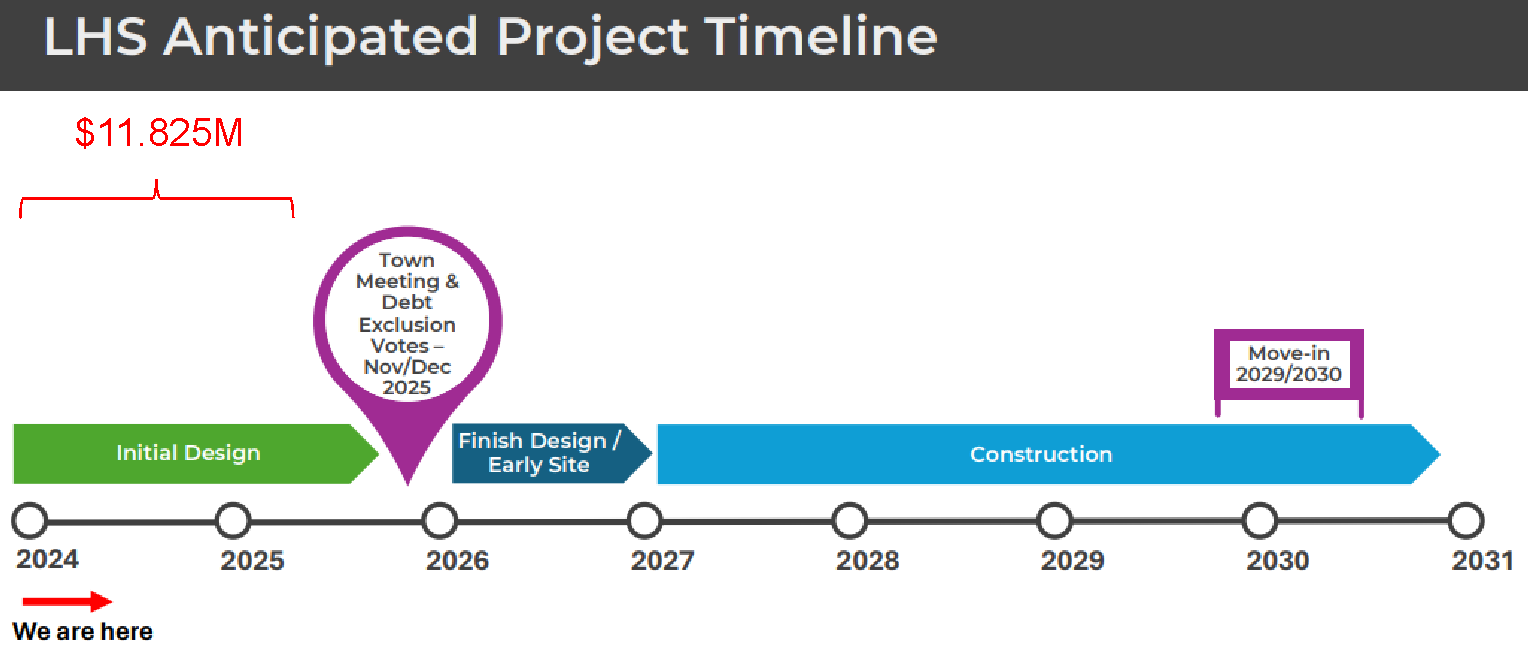
The journey to build a new high school is just beginning. Lexington is in the Feasibility Study phase. The work includes documenting the educational program, assessing the high school’s condition, setting design parameters, and developing and assessing alternatives. “Massing studies” provide conceptual planning diagrams, sizing, heights, and locations to enable initial cost estimates to be prepared. Lexington will provide these conceptual designs and initial costs with its recommendation to the MSBA for its approval. Lexington is far away from final siting locations, material selection, and budgets. Final design and construction will only commence after Town Meeting and voters (through a debt exclusion vote) approve the project, estimated to be at the end of 2025. The 2029-2030 timeframe represents a placeholder for an approximate move-in date.
After considering a number of alternatives, including some from the public, the School Building Project Team has chosen to move forward with five potential plans for further development: one involving renovation and addition to the existing high school and four involving new construction. The total estimated costs are similar among the alternatives, ranging from $600 to $635 million. The project website includes much discussion of the options along with the pros and cons of each.
Unfortunately, Lexington finds itself building a large project in a difficult post-pandemic construction environment. In general, the cost of construction continues to skyrocket, with shortages and supply chain issues driving up costs for professional services, labor and materials. Data collected by the MSBA documents the explosion in the cost of school construction.

Source: Lexington High School Project website
The new high school is not just about enabling Lexington’s academic vision. There are other scope elements that the Project Team is evaluating, including a new field house, office space for Central Office administration, structured parking, and perhaps a pool. Each of these scope additions are worth considering, but each adds complexity and cost to the project. Initial estimates suggest that scope additions add $20 to $180 million incrementally to the total project cost. Including all the scope additions results in an estimated total cost above $780 million.
Based on this work to date, Town Staff convened a Finance Summit on May 22, 2024 to obtain reaction and feedback to the estimated costs, taxpayer impact, bond structure, and use of stabilization funds for taxpayer mitigation. Given the importance of the project, attendees included the School Building Committee, Select Board, School Committee, Capital Expenditure Committee, Appropriation Committee, and Recreation Committee. No public comments were taken at this working meeting. “This is our largest budget summit ever, speaking to how large the high school project is,” concluded Carolyn Kosnoff, Assistant Town Manager for Finance, who led the discussion and presented the very informative and comprehensive materials, which included financial and project information.
The MSBA will only pay for a portion of the total cost — their contribution is currently assumed to be $100 million. This estimated MSBA grant represents between 13-17% of total cost depending on the ultimate scope chosen, which is lower than the statutory base rate of 31% which is the starting point for MSBA’s reimbursement calculations. Unfortunately, the MSBA has reimbursement caps and limits for a host of items related to design and construction to support the educational program. In addition, the MSBA will not fund “out-of-scope” facilities, such as new field houses (which include an indoor track), pools, or district office administrative space.
Therefore, Lexington will have to issue municipal bonds for the bulk of the total costs, probably in excess of $500 million for 30 years. Much discussion at the summit centered on the choice between repaying the bonds with a “level total payment,” similar to a 30-year fixed rate residential mortgage, or a “level principal payment.” A “level total payment” bond structure results in a lower taxpayer impact in the early years.
A debt issue of this size for the high school will more than double the Town’s total amount of outstanding debt. Lexington will then be in a highly leveraged position for the foreseeable future. We are lucky to live in a town with strong underlying economic fundamentals. The size of the high school project is not expected to impact Lexington’s outstanding AAA bond rating. What the Town can “afford” is thus ultimately subjective, to be determined by what taxpayers approve in a debt exclusion vote.
Taxpayers will of course have to pay back the debt. Staff estimated that the property tax increase (using the median Lexington home value of $1.354 million currently paying $17,000 in taxes) to range between $1,700 to $2,400 annually. This increase represents a 10-14% increase in annual taxes from the new high school alone.
This annual tax increase to pay for the high school is significant. Town Management realized long ago that this impact would be large and has built monies in a Capital Stabilization Fund (CSF) since 2013. In 2022, the Town also began to set aside some new commercial tax levy growth into the CSF. The Town will now be able to both (1) direct the commercial tax levy growth (about $4 million annually) to absorb debt service in the operating budget as well as (2) use the estimated $40 million fund balance to mitigate taxpayer impacts. Staff presented a number of options on how to use the CSF: comments from summit participants suggested an initial preference for using the CSF to ramp the impact from 2027 to 2034, thus delaying the full impact until 2035. Under this option that was modeled, tax increases would be in the 3-5% range for the early years, rising to a full 10% by 2035. One participant suggested a different option to use the CSF: to fully fund other larger capital projects that might be down the road (e.g., for the East Lexington Fire Station, for the upper floors of Cary Library, and for Clarke Middle School), thus avoiding future debt exclusion votes. Rest assured there will be much more discussion on mitigation strategies.
“The current Lexington High School served generations of students, but the time has come to look to the future. LHS is overcrowded with undersized classrooms and is ill-equipped to meet the needs of a 21st century education. This is an incredible opportunity for the Lexington community to imagine what we want for our high school students both now and in the decades to come,” said Kathleen Lenihan, School Building Committee Chair and School Committee Member.
The new Lexington High School represents a valuable as well as complex and costly project. As residents and taxpayers, we need to participate to shape the outcome. Lexington-focused online discussion forums and boards are full of “after-the-fact” comments where residents express surprise at a particular approved policy or project and lament that they did not know what was going on. A standalone $600-$800 million project screams out for lots of participation, dialogue, and scrutiny. In the private sector, for a mid-sized corporation, a single investment of this size would be considered a “bet-the-farm” decision and trigger a huge amount of analysis and discussion. The SBC already has conducted numerous outreach meetings and sessions. Many more are scheduled. As one might expect, many of the participants are residents with a student in the Lexington school system, school staff, and students. Engagement should increase substantially for members of the community that do not have a student in the school system. It is time to show up!
Administrative offices should not be located at the HS. The Center Recreational facilities will undoubtedly be affected by the HS and even more so with siting the new administrative office at the high school. They will also require the building of a parking ramp further impacting the land. Better options for the administrative offices are converting the temporary space on Bedford into a permanent space or leasing a privately owned office space.
The new school should not be placed on our center recreation land. This large open space is one of the “jewels” of Lexington. It is deed restricted for open space/recreation. To cut it in half with a 500,000 sq.ft 4 story building and replacing the lost fields on the present school site with lighted fields against people’s back yards is WRONG. It makes no sense to spend millions destroying fields recently renewed then spending more millions to rebuild them. Totally disconnected them from the core recreational facilities is destroying what makes the open space so special.
There are far better solutions. Ones that can achieve better results and save millions. Not sure? Just ask me how!! This project is important to everyone. It needs serious debate that challenges the present proposals. Thx, Peter Kelley
We need to explore alternative solutions. Please share with the various stakeholders.
Seems like Lexington needs to take a breather from what seems like a wild spending spree? Surprised that there are even fleeting concerns about the upper library levels when $4 million was recently allocated for a lower level reno for no critical reason.
We need to enlist the help of all the planners and builders in Lexington so that we come up with a plan that is cost effective, feasible, and has the least possible effect on open space. Sure, there are financial concerns but this building will be around for a long time; it need to serve a lot of purposes while being conducive to learning. Discussion is what’s needed, not “debate”. We need to build the school (any high school student can tell you why). Where and how we build will impact the town for generations.
The superintendent claims it will be cost effective to include space for the central office at the new high school (see her analysis linked in the article above). This is dubious. At the 17k *net* SF she specifies, that will add well over $20M to the cost (using the rule of thumb we were given of $1,300/SF). Meanwhile, office space can be leased at a tiny fraction of that cost (COVID has hurt the commercial office space market.)
[my comment, reformatted with paragraphs]
The Town has adopted municipal building codes that significantly raise the cost of construction in the post-pandemic environment (see https://www.lexingtonma.gov/560/Buildings-Development). The town should revoke or modify the building codes to make the construction of environmentally friendly buildings more affordable.
Most would agree that the new high school should not rely on fossil fuels for ordinary daily operations since those fuels will be phased out by 2050. But must the high school be its own renewable power plant, with geothermal for heat and enough solar to meet all its electricity needs? Must it use batteries for backup emergency power rather than diesel generators? Must it provide charging stations in the parking lot? All these items add cost, do little from a systems perspective to address climate change, and provide no educational benefit.
Similarly, the Town mandates that no materials from the Red List be used in construction, but strict adherence to the Red List raises material costs by 10%. No one wants to live and work in buildings made of dangerous chemicals, but that can be achieved without strict adherence to the Red List. The buildings where you and I live and work include materials from the Red List.
The building standards adopted by the Town are similar to that of new construction by private universities with large endowments where price is no object. These standards are beyond the means of municipalities and should be revoked.
Belmont just finished a $250m high school of similar size last year. Why does Lexington need to spend almost 3x as much? We need more transparency on the why. There should be a detailed explanation comparing our proposal to Belmont and Waltham. We should also see an alternative option that starts at $400m to $450m. The current proposal burdens taxpayers with too much debt. It’ll inevitably force cuts in other areas like teacher salaries at some point in the future.
https://www.usa.skanska.com/who-we-are/media/press-releases/275265/Skanska-completes-256-million-Belmont-Middle-and-High-School-in-Belmont%2C-Massachusetts
Quick research of nearby towns who recently built, or are currently building new high schools, show the cost significantly lower than what Lexington wants to spend. At Lexington’s high-end estimate, costs are nearly 2.5X any other Highschool build in the general area over the past few plus years! Even if the #’s on recent builds below are 30-50% off … Lexington’s $’s are too high even at the low-end estimate! The design plan in Waltham was $4-5M and Lexington will pay $10M for the design. Am I missing something in the 2-minute research I did? Feels like a wild spending spree as Gary suggests above!
Belmont – $310M with ~2,200 students (Finished in ~ Sept. 2021)
Arlington – $280M with ~1,800 students (Just finished or finishing construction)
Waltham – $375M with ~1,800 student (Currently under construction)
Lexington – $620M-$800+M ~2,300 students (Currently in planning stages)
Why do the handful of options, including renovations to the existing high school, all have essentially the same price tag? Is it $600 to $635 million, or $780 million or potentially even more because “Unfortunately, Lexington finds itself building a large project in a difficult post-pandemic construction environment. In general, the cost of construction continues to skyrocket, with shortages and supply chain issues driving up costs for professional services, labor and materials.”?
I would like to see a detailed breakdown on what is contributing to the projected cost of the high school. I am sure many of us would like to drive a Ferrari but we put some constraints on our expenditures.
In addition, reviewing the cost of the neighboring high school’s built would definitely be worthwhile. Some compromises no doubt were made.
It seems the committees for the school project are doing great work – and may feel a bit like Sisyphus pushing that rock as well given the rising costs of the project. Two questions:
1. Is there or could there be a concerted effort on the part of the committees involved with finding funding alternatives to plumb HUGE philanthropic avenues? I don’t know who would do that in Lexington or in association with educating Lexington youth. But I write this because I also didn’t know of such a possibility when a neighbor here in Lexington gave BU $100 million shortly before he passed away last year. Certainly the MSBA is doing this in its own way, but apparently does not help support a number of high cost components of the Lexington High School project.
2. The proposed cost for the project for Lexington High is without doubt the single most expensive high school project ever conceived and invited into the MSBA process. The MSBA is a remarkable state agency and funding source. It would seem to be incumbent on the planning committees to use this resource as efficiently as possible such that reimbursement of project costs from the MSBA be essentially maximized. While conceptually that approach may run counter to some of the highly desired features the committees desire that are not within the scope of MSBA funding, not doing so pushes the Town closer and closer to a “go it alone” funding strategy.
That said – it makes sense to try and find the needles in the haystack that would be able to “give” Lexington $100 million. It appears the high school project needs 3 to 5 of them.
Similarly – it is probably incumbent on the committees to strongly consider an alternative scope of project that would get the cost of the project into a relationship with MSBA guidelines that would allow the MSBA to fund at least 40% of the cost of the project. I fear not doing so fails the tax base of our town – especially in our local portion of the world where “everything costs more” -and sets a poor precedent for the next important school project that could be considered by the MSBA for its program.