


Local government agencies are full of acronyms, but what do they stand for, and what do they do?
The Lexington Observer did a deep dive with Caileen Foley, the director of LHA, Lexington’s Housing Authority, about the agency’s current projects and future plans.
Foley began by showing me around the first of three Lexington Housing Authority sites, Vynebrooke Village, which is undergoing over $5 million in capital improvements. We then toured the Greeley Village apartments, where we find some small one-bedrooms are well-appointed with new bathroom fixtures and kitchen upgrades which bring them out of “That 70’s Show” and transform them into clean, modern apartments looking out onto surrounding well-kept grounds, with small individual allotments facing an internal courtyard and plants tended to by resident volunteers.


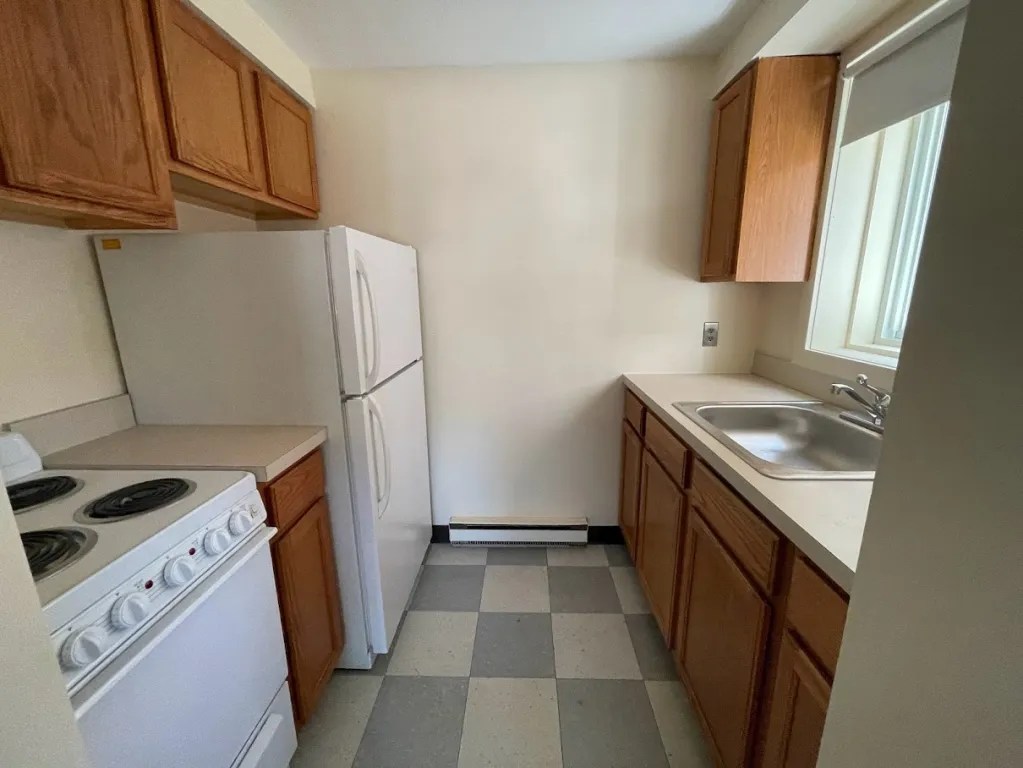
Photo credit: Lisa Guidetti
The Lexington Housing Authority owns, operates, and maintains three large housing complexes. The smallest is Vynebrooke Village, with 48 units for low-income and elderly residents, 3 of which will be fully handicapped accessible by the end of these renovations. The next largest is Countryside Village, with 60 units for the elderly, some modified for accessibility. The largest in their public housing portfolio is Greeley Village, with 104 apartments for the elderly and handicapped. They also have 17 so-called “scattered” sites around town — single-family homes ranging in size from 2 to 4 bedrooms. Five of LHA’s houses are contracted out to the Department of Developmental Services (DDS), which offers housing to residents with intellectual and developmental disabilities and provides on-site care.
Many of these properties fall under either a state (Vynebrooke Village and Greeley Village) or federal (Countryside Village) funding umbrella, or sometimes a combination of the two, with some local Town funding in the mix. The federal program is subsidized through Housing and Urban Development (HUD) and the state program through the newly coined Executive Office of Housing and Economic Development (EOHED), known until recently as the Department of Housing and Community Development (DHCD).
This is an invisible distinction for the tenants, but to Caileen Foley, it represents the matrix of funding and accountability that LHA is charged with navigating to serve its residents.
This interview has been edited for length and clarity.
Lisa Guidetti: Who lives in LHA housing, and how do you prioritize when we are in the midst of a housing crisis?

Caileen Foley: There is an income qualification; they use 80% of the Area Median Income (AMI, it’s a HUD term). Most of our residents are extremely low income, which means they earn less than 30% of the AMI. We give preference and priority to local residents. In our elderly units, 65% are Asian, mostly Chinese. Others are mostly caucasian.
The state side has implemented a centralized waiting list over the past couple of years, and through that, we’ve lost a little bit of our autonomy in managing the wait lists. They now dictate who gets priority. It’s a really heavy push on housing people with homeless status first, which is understandable. But on the federal side, it’s still local preference, which means people who either live or work in town. There’s also a veteran preference.
Then there’s brick-and-mortar public housing, where we own the units, we own the land, etc, and there’s a voucher side to that, which is Section 8 federally or MRVP (Mass Rental Voucher Program) on the state side. There are some different rules associated with them; for example, HUD might have different eligibility rules related to immigration status. The state has more open rules regarding eligibility because Massachusetts is a “Right to Shelter” state, so the barriers to housing are a little bit less in that program.
Guidetti: How does the housing authority maintain and grow its housing portfolio to serve a changing affordable housing landscape?
Foley: It’s hard for housing authorities to create new units just as a housing authority. We are a government agency, you know what I mean? So we can’t mortgage properties, we can’t go get loans. We’re pretty bound to the rules and regulations of these truly bureaucratic systems, so it makes it hard to create things. But there are ways. LexHab, for example —which is the other affordable housing provider in town — is a non-profit.
We are in the process of repositioning our federal portfolio from traditional HUD subsidies to Section 8 vouchers. The federal government would like to get out of the business of public housing. They would like to transition a lot of the public housing into a Section 8 type model, where you can charge based on the market rate and that’s paid for with vouchers, but then they’re not going to give you any operating or capital money. It gives us more autonomy and honestly more money, which we can use to modernize and develop. It opens more doors for us.
A lot of agencies are doing this type of repositioning funding and creating units. They’re looking at their portfolio, and they’re saying, for example: I have seventeen scattered sites; they each sit on a piece of land. Back in the 70s, they plopped a little house on it, but let’s look at it now. Could we develop that into two townhouses? Could we create four units out of that one? So that’s the Board and my goal, for the next five years — to really look at what we have and try and figure out these new funding streams and literally create new units. We think the town is supportive of affordable housing and that they would support us in that type of endeavor. So that’s the way we’re going to try and help create more affordable housing for the town.
Guidetti: Tell us about some of the recent improvements you’ve been making.
Foley: There’s a huge push across the state to create more affordable housing, which is wonderful and is definitely needed. But there is also a real importance to maintaining what’s already here.
Every five years, we do a Capital Study to see the status of our units. But we also have a running knowledge of what needs to get done. We are continuing on with the large renovation at Vynebrooke — which includes all new kitchens and baths. We’re taking all the tubs out, putting in walk-in showers, all new toilets, vanities, lighting, all new kitchen counters, cabinets, appliances, and then they’re refinishing all the floors, they’re painting all the walls. So they look pretty spiffy. Three of the units there, part of the funding was to make them fully accessible. That project is in the final phase, we’re hoping to finish the accessible units in January.
At Greeley Village, we are doing new bathroom medicine cabinets and lighting fixtures. The residents down there would love new kitchens and baths, but I don’t have another 5 million, so we’re doing what we can!
We applied for ARPA funding, and we received it to do all new fire alarm systems at both Greeley and Vynebrooke. That’s over a million-dollar project, and it will just be full new fire alarm systems at both locations.
There are a lot of incentives for affordable housing to go the energy-efficient route, which is great. At no cost to us, we were able to install a hundred heat pumps at Greeley and 48 at Vynebrooke. The State paid for everything. But the state really likes to see sustainability measures put into place with capital projects, and they’ll give you more money if you are doing those measures. So we now have low-flow toilets, we have the heat pumps. The only place we have oil is at the scattered sites, but we are in talks about possibly trying to convert those houses. So we’re in pretty good shape for sustainability-wise.
Guidetti: While the bricks-and-mortar issues are of obvious priority, LHA must remain sensitive to residents’ social and healthcare needs (though not directly charged with providing those services to their tenants). How do you do that?
Foley: We like to say we’re just landlords, but there’s so much more to it than that. You know, my day could switch the moment you leave — all of a sudden, I’m calling social workers, “Do you think you could go check on Mrs. Smith?” etc. It is very demanding, as our population ages, what their needs are. A lot of times they don’t have family, or they don’t know how to reach out appropriately. It can be challenging.
We’ve had many elderly residents who — obviously, I won’t name any names, but we had this elderly person who was severely handicapped and their apartment was in really bad shape — like hoarding and filth, squalor. The Board of Health came in and condemned the unit. The traditional route for a housing authority is to then evict. You’re breaking your lease, here’s your 30-day notice, let’s go through the steps — get out. But then where do they go? We are at the end of the road, you know? So, if we’re the end of the road, what’s beyond us?
Sometimes you kind of go through those motions to get people into compliance. Getting that 30-day notice or getting that court order allows somebody to kind of step in and bring in services. That’s not the road I like to go because it’s pretty aggressive.
What we’ve done the past couple years is sign an agreement with Minuteman Senior Services. I can talk with the caseworker there about what the situation is and then they bring in services.
We have also hired a Resident Service Coordinator who meets with clients and assists them with whatever their needs are, from setting up transportation or, you know, VNA services, or even bringing in housekeeping. He’s wonderful. He’ll say all the time, “Oh, Mr. So-and-so just wanted to chat,” and that’s all they want. Or in more extreme situations, “You need to call the protective services, that person is a harm to themselves.” He speaks Chinese, so he’s reaching that whole client base, who sometimes don’t reach out to us because of language issues or cultural issues. He’s been able to sort of bridge that gap.
Our goal is never to evict. We really, really want to just help the people get into a better situation so they can live comfortably.
I’m glad to learn more about the LHA and their current projects and priorities. Please note that the Department of Developmental Services (DDS) supports individuals with intellectual and developmental disabilities. The Department of Mental Health (DMH) supports individuals with mental health disabilities.
Thank you! Edited the post to reflect this correction.